
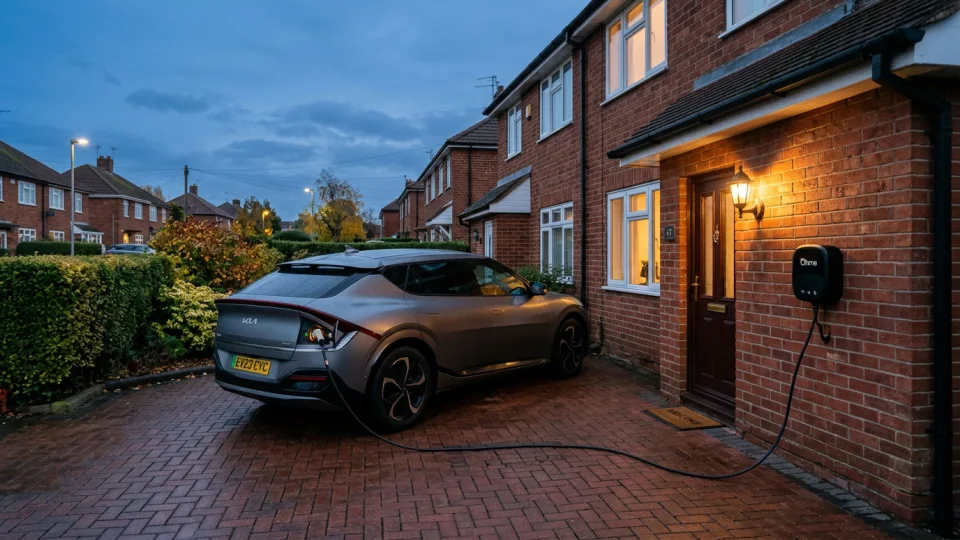
As electric vehicles move from early-adopter driveways onto millions of residential streets and terraced kerbs across Great Britain and Northern Ireland, a power cut or local broadband drop creates brand-new household questions that traditional petrol drivers never faced. Can a wallbox trap your Type 2 charging cable locked inside the car when the street goes dark? Why do smart tariffs stop charging even when household lights come back on after a brief voltage dip? And under UK wiring rules, can you safely run your fridge or broadband router from an EV battery using Vehicle-to-Load (V2L) without creating lethal danger for linespeople repairing your neighbourhood transformer?
1. What Happens to a Home EV Wallbox During a Grid Outage or Voltage Dip?
Every compliant 7kW domestic alternating-current (AC) wallbox sold in Great Britain must comply with the Electric Vehicles (Smart Charge Points) Regulations 2021 and BS 7671 Section 722 wiring safety standards. Rather than holding live mains voltage blindly at the Type 2 plug pins, a modern wallbox communicates constantly with your car’s onboard charger through a low-voltage Control Pilot signal and monitors incoming supply health before closing its internal relay.
The moment a local Distribution Network Operator (DNO) fault interrupts supply on your street—visible anytime on our live UK power cut map—the wallbox immediately drops its contactor open and halts charging cleanly without harming your vehicle’s high-voltage traction battery. However, two nuisance side effects routinely surprise UK drivers immediately afterward:
- Type 2 Locking Pin Traps on Some Vehicles: Many cars keep their charge port motor locked while charging was active or while 12V auxiliary actuators wait for a fresh unlock command. Before tugging forcefully at a stuck Type 2 plug in the dark, press the physical unlock button on your key fob twice cleanly (wait 10 seconds for relays to cycle), open the driver’s door, check for a reduced-current “stop charging” option inside the vehicle dashboard, or consult the handbook for the insulated emergency manual release pull-cord tucked behind the boot trim.
- O-PEN / PME Protective Earth Lockouts After Brownouts: UK homes wired on TN-C-S Protective Multiple Earthing (PME) supplies depend on a continuous combined neutral-earth conductor. When a storm causes brief voltage sags outside normal statutory limits (typically dipping below ~207V or spiking over ~253V), built-in PEN fault protection electronics inside smart wallboxes trip deliberately into safety lockout. A flashing red status LED after street lights return frequently means the wallbox expects a 60-second breaker isolation reset at your home consumer unit rather than indicating permanent hardware damage.
2. Smart Charging Tariffs vs Wi-Fi & Cloud Platform Outages
Most UK off-peak EV tariffs—such as Intelligent Octopus Go, OVO Charge Anytime or ScottishPower EV Saver—rely on cloud API telemetry travelling continuously over mobile 4G/OCPP SIMs inside the charger or through your home Wi-Fi broadband router to schedule half-hour charging slots automatically. Even when mains electricity never goes out at all, an upstream ISP outage on our UK Broadband tracker or a supplier billing platform slowdown can interrupt smart scheduling:
| Failure Scenario | Why Your EV Failed to Charge Overnight | Practical Morning & Contingency Step |
|---|---|---|
| Street DNO Power Cut During Off-Peak Window | Mains electricity physically absent across scheduled 23:30–05:30 slot; wallbox shuts relay safely. | Check regional DNO status or 105; switch charger to temporary daytime boost once grid recovers if journey range is urgent. |
| Home Broadband Outage (Router Offline) | Wi-Fi-only wallboxes cannot fetch dynamic OCPP charging tokens when home fibre drops overnight. | Enable charger “Plug & Charge” offline fallback inside installer/user app, or temporarily hotspot charger Wi-Fi onto a spare mobile phone. |
| Supplier Cloud API / Platform Freeze | Vehicle telematics fails API handshake so smart charging algorithm leaves car idle at 20%. | Bypass app scheduling using “Bump Charge” or schedule in-car 00:30–05:30 timer directly so vehicle draws base off-peak energy reliably. |
| Randomised Delay Offset Wait | Statutory UK Smart Charge Regulations add an automatic up to 10-minute (30-min peak) random start delay after grid restoration. | Wait 15–20 minutes after power returns before assuming a tripped charger—the amber/blue pulse simply indicates mandatory randomised delay staging. |
3. Safe Vehicle-to-Load (V2L) Emergency Backup vs Forbidden Backfeeding
A growing wave of modern EVs sold across Britain—including Kia, Hyundai, MG, BYD, Volvo EX models and Renault—include Vehicle-to-Load (V2L) adapters delivering 2.2kW to 3.6kW at standard UK 230V/50Hz AC straight from the Type 2 port. Sitting on a 60kWh to 80kWh drive battery during an extended winter blackout sounds miraculous: running a 120W fridge-freezer, fibre ONT box, laptop charger and LED lamps consumes barely 250W combined, giving theoretically more than a week of domestic bridge power before dipping to a 20% vehicle reserve floor.
However, Energy Networks Association engineers and BS 7671 electrical safety standards enforce one absolute life-safety boundary: never attempt to feed V2L AC power backward into a domestic wall socket using an illegal double-ended “suicide” male-to-male mains lead. Doing so without an approved DNO-notified automatic changeover switch risks energising neutral or phase conductors outside into the street cable, threatening electrocution to field engineers working on isolated transformers—and destroying vehicle inverters instantly the moment utility mains re-closes out of phase.
- Safe Method 1 — Dedicated Extension Leads From the V2L Port: Park safely outside with the weather-sealed V2L adapter fitted cleanly inside the boot or external socket, and bring a single heavy-duty weatherproof 13A RCD-protected cable reel indoors through a carefully sealed window or trickle gap solely to power standalone free-standing appliances (fridge-freezer, router, phone banks, CPAP backup chargers). Never coil extension leads tightly under continuous 1.5kW+ loads; unroll the reel fully to avoid thermal melting.
- Safe Method 2 — Certified Vehicle-to-Home (V2H) Transfer Switchgear: Only bidirectional V2H chargers installed under formal DNO G98/G99 connection notice with mechanical grid-isolation relays may energise whole-home backed-up circuits automatically during power cuts.
4. Public Rapid Charger Outages & UK 99% Uptime Laws
When domestic power is off across an entire rural parish, many EV households rely on commercial motorway hubs or supermarket DC rapid chargers ten miles away—check live charger operator networks anytime on our UK EV Charging Status hub or calculate top-up electricity cost with our EV Charge Cost Calculator. Under the UK Government’s Public Charge Point Regulations 2023 overseen by the Office for Zero Emission Vehicles (OZEV):
- Mandatory 99% Annual Network Reliability: Public rapid charge point operators delivering 50kW+ chargers must achieve a 99% operational uptime benchmark averaged across their UK rapid fleet each calendar year, publishing live availability status through open data feeds so drivers are never directed blindly toward broken bays.
- Free 24/7 Live Telephone Helpline: Every public charge point bay must display a working, staffed 24-hour freephone or standard emergency support number capable of remotely rebooting frozen OCPP sessions or unlocking jammed CCS latches on site.
- Contactless Payment Without Mandatory App Sign-Ups: New 8kW+ and existing 50kW+ public rapid chargers must accept standard contactless debit/credit cards so drivers are never trapped at empty battery inside a mobile signal dead zone where charging apps fail to load.
5. Essential EV Blackout Checklist Before Severe Met Office Warnings
Whenever yellow, amber or red Met Office wind warnings threaten overhead lines in Scotland, Wales, Northern Ireland or rural England, follow three smart prep habits 24 hours ahead: pre-charge your traction battery to 80%–90% before high winds peak (leaving sufficient margin both for an urgent trip out and potential V2L fridge support), test your physical V2L discharge adapter or 12V inverter kit outdoors in daylight so you know exact menu switches, and double-check that your 105 DNO emergency number and Ofgem compensation timeline are bookmarked offline on your mobile phone. Taking twenty minutes ahead of winter storms keeps both household resilience and clean mobility running without panic.