
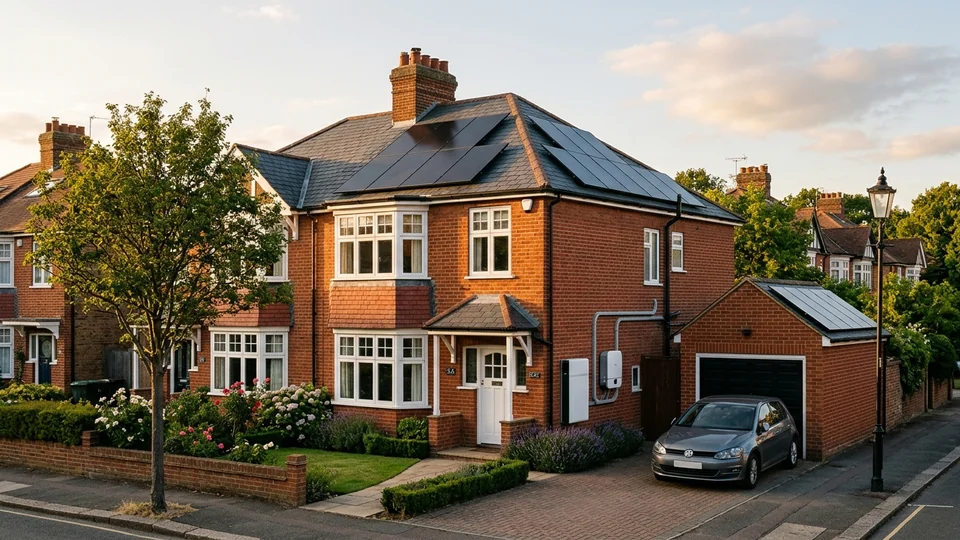
Thousands of British homeowners who invested £9,000 to £15,000 in rooftop Solar PV panels and sleek garage-wall home lithium batteries experience a shocking disappointment the first night their street experiences a power cut: despite storing 10 kWh of electricity on the wall, the house lights flick out alongside every neighbour’s. Understanding why statutory UK grid safety codes enforce automatic shutdown, how an Emergency Power Supply (EPS) gateway safely isolates a home during blackouts, and how to size a modern LiFePO4 (Lithium Iron Phosphate) battery bank realistically for dark British winters turns rooftop solar into true storm resilience.
1. The Anti-Islanding Surprise: Why Standard Solar Inverters Shut Down
No fault has occurred when a conventional solar-plus-battery inverter powers down cleanly the instant street mains drop to zero volts. By law across the United Kingdom, every standard grid-connected microgeneration installation complies with Energy Networks Association engineering recommendations G98 (up to 3.68 kW per phase) or G99 (larger domestic and commercial arrays).
Protecting DNO Linespeople Under ENA G98 & G99 Anti-Islanding Rules
Both statutory standards enforce strict loss-of-mains (anti-islanding) shutdown within fractions of a second whenever grid voltage or frequency drifts outside safe limits (typically 50 Hz ± narrow thresholds). Why? When DNO linespeople isolate a rural 11kV transformer or climb an icy pole believing cables are safely dead, a rogue solar inverter exporting power back into street mains could step-up voltage dangerously through street transformers, putting repair engineers’ lives at immediate risk. Consequently, unless your electrician installed certified physical transfer switching separating your home completely from incoming DNO meter tails, your inverter must sit safely idle throughout the entire street outage.
2. Single-Socket EPS Outlets vs Whole-Home Automatic Gateways
Households wanting genuine backup supply during power cuts have two approved British engineering designs—each carrying sharply different budgets, wiring rules and convenience levels:
Option A: Dedicated Single EPS Socket or Critical-Load Consumer Board
Many popular hybrid inverters include an inbuilt backup output terminal rated around 3 kW to 5 kW. During an installation upgrade, your MCS/NICEIC electrician wires either a dedicated double 13A emergency socket right beside the inverter or a small protected critical-load sub-consumer unit feeding solely your gas boiler spur, Wi-Fi ONT/router circuit, kitchen fridge-freezer and hallway LED lighting. When a blackout occurs, most standard systems pause for 1 to 10 seconds before islanding that critical sub-board cleanly on battery power without bothering high-draw electric showers, ovens or EV chargers.
Option B: Whole-Home Automatic Islanding Gateways & BS 7671 Earth Rods
Premium integrated systems—such as Tesla Gateway 2/3, GivEnergy All-in-One Gateway or modern whole-home hybrid changeover controllers—monitor incoming grid voltage continuously and open a physical motorised contactor disconnecting your house’s supply tails from the DNO network in under 20 milliseconds. Your fridge does not even blink, and any power-hungry circuit on your consumer unit operates cleanly up to your inverter’s continuous kW ceiling.
Crucially, under BS 7671 IET Wiring Regulations, whenever a UK home equipped with standard TN-C-S (PME — Protective Multiple Earthing) drops off the grid in true island mode, it legally loses its grid neutral-earth bond reference and requires its own tested dedicated TT earth electrode rod plus suitable RCD protection before islanding is legal. Never attempt DIY wiring or purchase uncertified male-to-male suicide extension leads attempting to back-feed home sockets—both risk fatal electrocution and invalidate UK buildings insurance.
3. Sizing a LiFePO4 Battery for Realistic British Winter Storms
British households average roughly 8 to 10 kWh per day year-round—yet during overcast December weeks in Yorkshire or Scotland, a 4 kWp rooftop array often yields barely 1 to 2 kWh on gloomy days while heating circulation pumps, dark lighting and hot drinks push demand upward. Compare actual outage durations and storage headroom cleanly using our UKOutage Solar & Home Battery Backup Calculator and UK kWh Appliance Cost Estimator.
Pre-Charging Storm Reserve & Avoiding Deep Winter Discharge
- Use Storm Watch / Backup Reserve Modes: Most smart UK battery apps let you reserve 20% to 50% minimum State of Charge (SoC) year-round—or force-charge the battery cheaply up to 100% overnight on off-peak agile/EV tariffs whenever Met Office Amber wind warnings drop.
- Realistic Load Discipline During Blackouts: Turning off an electric kettle (3,000W), tumble dryer (2,500W) and electric oven extends a 9.5 kWh usable LiFePO4 battery powering strictly a gas boiler pump (90W), fridge-freezer (80W average), fibre ONT/router (25W) and laptop charging (60W) from barely 8 hours to well over 30 continuous hours—and daylight diffuse winter solar trickle-recharges batteries further once EPS black-start capability wakes panels cleanly.
- Check Cold-Weather Placement: Modern lithium batteries degrade prematurely or electronically throttle charging below 0°C unless dedicated internal thermal heating pads exist; always locate EPS battery racks inside insulated utility rooms, basements or ventilated frost-protected brick garages rather than exposed wet external north-facing garden walls during biting UK frosts.
4. Portable LiFePO4 Power Stations vs Wired Backup Transfers
Renters, flat dwellers and homeowners on smaller budgets do not need £10,000 rooftop arrays to protect essential medical equipment, broadband and fridge food overnight. Modern 1 kWh to 2 kWh pure-sine-wave LiFePO4 portable power stations operate silently indoors with zero fumes, run laptops, CPAP sleep machines and fridge-freezers safely via standard UK three-pin sockets, charge back to full capacity within 90 minutes from mains power or optional portable folding solar blankets between storms, and double as outdoor camping or caravanning supplies year-round. Remember to cycle storage power stations slightly down and back up roughly every six months per manufacturer instructions rather than shelving them flat at zero percent all summer. Compare appliance loads cleanly with our UK Backup Generator & Power Station Sizing Tool before winter arrives.
Managing High-Draw Circuits: Heat Pumps, Induction Hobs & EV Chargers
A common engineering pitfall when commissioning a whole-home 5 kW EPS gateway involves leaving 7 kW EV wallboxes, 10.5 kW instant electric showers or 9 kW air-source heat pump backup immersion rods wired straight across the backup supply bus. One unsuspecting shower switch-on mid-blackout immediately overloads a 5 kW battery inverter, tripping backup power across the entire house into temporary shutdown! Ask your NICEIC installer to wire high-draw circuits onto a non-backed load board (upstream of the islanding gateway) or install automated smart load-shedding contactors so essential lighting, boiler pumps, security cameras and broadband remain rock-steady around the clock.
5. UK Export Caps, Grid Restoration Surges & Annual EPS Testing
Before installing residential storage, confirm your licensed DNO’s approved export ceiling under ENA G98 (up to 16A / 3.68 kW single-phase notification) or G99 (prior DNO network study for 5 kW–11 kW+ arrays)—your installer handles formal notification directly with UK Power Networks, NGED, SSEN, Northern Powergrid, ENWL, SP Energy Networks or NIE Networks. Where weak rural street transformers cannot accept large daytime solar export, DNOs frequently issue G100 Export Limitation Agreements pairing a calibrated CT current clamp on your incoming tails so panels power your home battery without spilling excess power backward. Once commissioned, schedule an annual two-minute test: toggle your consumer-unit mains isolator briefly during daylight hours to verify automatic EPS islanding changeover engages smoothly, confirm warranty cycle allowances permit off-grid discharging, check rotary earthing continuity certificates remain filed with your buildings insurer, and press RCD test buttons quarterly so safety trip mechanisms never seize mechanically during prolonged winter blackouts.