
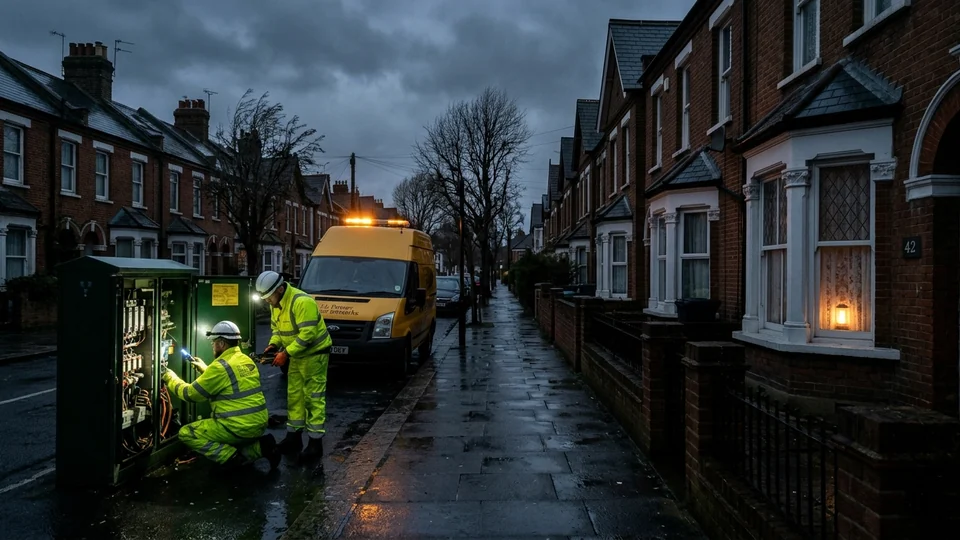
When domestic lighting suddenly extinguishes, residents turn to live telemetry radars expecting a rapid 2-to-3-hour resolution. However, when monitoring scheduled grid upgrades across the United Kingdom, visitors occasionally encounter countdown timers spanning 100 to 160+ hours—such as an active restoration window extending over an entire week. Understanding why licensed Distribution Network Operators (DNOs) schedule multi-day planned power cuts, how engineering teams calculate an Estimated Time of Restoration (ETR), and what legal notice you are owed under Ofgem regulations ensures your household stays safe, prepared, and legally protected.
Emergency Faults vs. Planned Works: Why Do Some UK Power Cuts Span 100 to 160+ Hours?
Across England, Scotland, and Wales, physical power transmission and regional distribution are maintained by six regulated engineering consortia operating 14 regional distribution licences. In the electrical utility sector, power outages fall into two fundamentally distinct categories:
- Unplanned Emergency Disruptions: Triggered unexpectedly by lightning strikes, windstorms, underground cable insulation breakdown, or mechanical digger strikes. These faults are isolated rapidly using automated telemetry, with emergency response crews dispatched immediately to achieve restoration within 2 to 12 hours.
- Planned System Maintenance & Grid Upgrades: Pre-arranged capital investment works required to replace aging high-voltage switchgear, install heavy-duty transformers, rebuild rotten wooden poles, or connect new clean-energy substations to the regional grid.
When an extensive capital maintenance programme is logged on national telemetry feeds, the overall project duration is frequently scheduled across an entire working week—often displaying 160 hours or more between the initial system isolation and final project completion.
Importantly, a 160-hour planned maintenance window does not mean affected homes and businesses will sit in continuous total darkness for seven uninterrupted days. Instead, modern network operators employ staged, rolling feeder switching. Overhead line teams isolate specific high-voltage (11kV) lateral spurs for designated 6-to-8-hour daylight shifts to allow linesmen to climb and rebuild poles safely. Circuits are often back-fed via secondary automated ties or mobile generators during evening and morning peak hours, while the master engineering ticket remains formally active until final commissioning.
Real-World Telemetry Case Study: The Haxey (DN9) 161-Hour Planned Maintenance Window
A prominent real-world example of extensive infrastructure overhaul occurred on the South Yorkshire and North Lincolnshire border in Haxey (DN9 postal district, incident reference #8428). Regional telemetry feeds recorded an active power cut managed by Northern Powergrid (Yorkshire) with an initial logged timestamp of 18 November 09:00 GMT and a targeted Estimated Time of Restoration (ETR) scheduled for 25 November 11:30 GMT—representing a 161-hour (approx. 7-day) operational timeline.
Under NPG reference PPCR81062 (where the PPCR prefix formally denotes a Planned Power Cut Reference rather than an unplanned INCD emergency), the official network log stated:
"Planned Work on System: We need to temporarily turn the power off to carry out a permanent repair and system modernisation in the area."
In rural and semi-rural distribution zones like the Isle of Axholme, high-voltage overhead lines run across agricultural land and marshy terrain, exposed to severe winter gales and corrosion. Replacing aging porcelain insulators, installing automated sectionalisers, and clearing extensive tree canopies across miles of 11kV cross-country lines cannot safely be rushed in a single afternoon. By scheduling a multi-day window, engineers ensure permanent network resilience, preventing recurrent winter blackouts for hundreds of local properties.
How UK Network Operators Calculate and Adjust Estimated Time of Restoration (ETR)
The Estimated Time of Restoration (ETR) displayed on utility apps, SMS alerts, and national monitoring radars is not a static guess; it is calculated using dynamic Supervisory Control and Data Acquisition (SCADA) algorithms combined with live field engineer progress reports.
When evaluating complex repair timelines, DNO control rooms follow a disciplined seven-stage operational pathway:
- Automated Feeder Tripping & Telemetry Logging: Circuit breakers at primary substations trip to de-energise compromised conductors, logging the incident with an initial automated baseline ETR (typically 3 hours for emergency faults, or the scheduled project end-date for planned work).
- Remote Fault Isolation: Tele-control engineers operate automated switching points along the feeder to back-feed unaffected spurs, restoring power to up to 80% of downstream premises within minutes.
- Physical Line Patrol & Thermal Imaging: For overhead lines, linesmen physically walk the route or deploy diagnostic drones to pinpoint snapped conductors, broken crossarms, or windblown debris. For underground urban cables, specialist fault-finding vans employ acoustic pulse generators ("thumpers") and time-domain reflectometry.
- Safety Earthing & Permit to Work: Before any technician touches physical apparatus, portable earths are clamped onto the conductors to eliminate residual capacitance and prevent accidental back-energisation from domestic solar panels or customer backup generators.
- Excavation, Splicing & Heavy Replacement: Damaged high-voltage cables are excavated, cut back, and jointed using resin-injected pressure sleeves, or overhead conductors and rotten poles are physically craned out and replaced.
- High-Voltage Pressure Testing: The repaired circuit undergoes rigorous insulation resistance and dielectric testing at 11,000 to 33,000 volts to verify zero leakage to earth.
- Step-by-Step System Re-Energisation: Substation circuit breakers are manually closed, load telemetry is verified, and the incident is formally closed on the national hub.
If a planned repair encounters hidden underground corrosion, severe lightning storms that halt crane operations, or structural damage requiring specialized replacement parts, DNO control engineers will dynamically push back the target ETR to protect field crews.
Ofgem Statutory Notice Rules: What Are Your Rights Under SI 2015/699?
To prevent network operators from turning off domestic electricity without adequate warning, Great Britain's energy regulator, the Office of Gas and Electricity Markets (Ofgem), enforces strict statutory consumer protections known as the Guaranteed Standards of Performance (GSS), enacted under the Electricity (Standards of Performance) Regulations 2015 (Statutory Instrument 2015 No. 699).
Under Standard 8 (Notice of Planned Interruption to Supply), your licensed DNO is subject to legally binding obligations:
| Regulatory Rule | Statutory Requirement | Guaranteed Compensation |
|---|---|---|
| Advance Notice Requirement | DNO must deliver written notice at least 2 clear working days in advance (most DNOs provide 5 to 10 days). | £30 (domestic) / £60 (non-domestic) if notice is missing or late. |
| Late Payment Penalty | Compensation must be credited or paid by cheque within 10 working days of the incident. | Additional £30 automatic penalty for delayed settlement. |
| Short-Notice Cancellation | If the planned power cut is cancelled with less than 24 hours' notice without valid emergency justification. | £30 cancellation compensation. |
| Extended Outage Beyond Schedule | If power remains off beyond the stated notification window for more than 12 continuous hours. | Standard £95 unplanned outage compensation applies. |
If your network operator cut off power for planned works without dropping a formal letter or card through your letterbox, or if the outage overran significantly beyond their scheduled restoration window, you can run your exact timeline through our free UK Power Cut Compensation Calculator to ascertain your statutory payout.
Essential Household Protocols During Sustained Planned Maintenance
If your postal district is scheduled for extensive network modernisation or lateral feeder replacement, taking proactive precautions prevents property damage and household distress:
- Unplug Sensitive Consumer Electronics: High-voltage switching operations can produce minor transient voltage spikes as circuits are energised and de-energised. Unplug high-end desktop computers, OLED televisions, and smart home hubs from wall sockets prior to the scheduled start time.
- Protect Home Medical Equipment (The Priority Services Register): If anyone in your household relies on mains-powered medical devices (such as CPAP machines, home dialysis units, or nebulisers), is of pensionable age, or has young infants, register immediately on the free Priority Services Register (PSR). During prolonged planned works, DNOs provide advance welfare check-ins, heavy-duty battery power packs, and emergency generator support.
- Preserve Domestic Cold-Chain Storage: Keep refrigerator and upright freezer doors strictly closed. According to the UK Food Standards Agency, a closed refrigerator remains safely chilled for 4 to 6 hours, while a fully stocked chest freezer maintains sub-zero food safety for 24 to 48 hours without electricity.
- Check Solar PV & Home Storage Inverters: Standard domestic grid-tied solar systems automatically disconnect within milliseconds during a power cut to prevent energising the street lines where technicians are working (anti-islanding protection). Only hybrid systems fitted with dedicated Emergency Power Supply (EPS) contactors and isolated backup consumer units will supply domestic power during the maintenance window.
How to Verify and Corroborate Live Grid Disruption in Your Area
If you experience a sudden loss of electricity and are unsure whether it stems from an unplanned emergency trip, a scheduled multi-day feeder overhaul, or an internal circuit breaker issue, check the live national telemetry radar on UK Power Cuts Overview. You can corroborate neighbourhood disruption, check your DNO's official restoration timeline, or report an unlogged incident via our citizen portal at Report a UK Outage.