
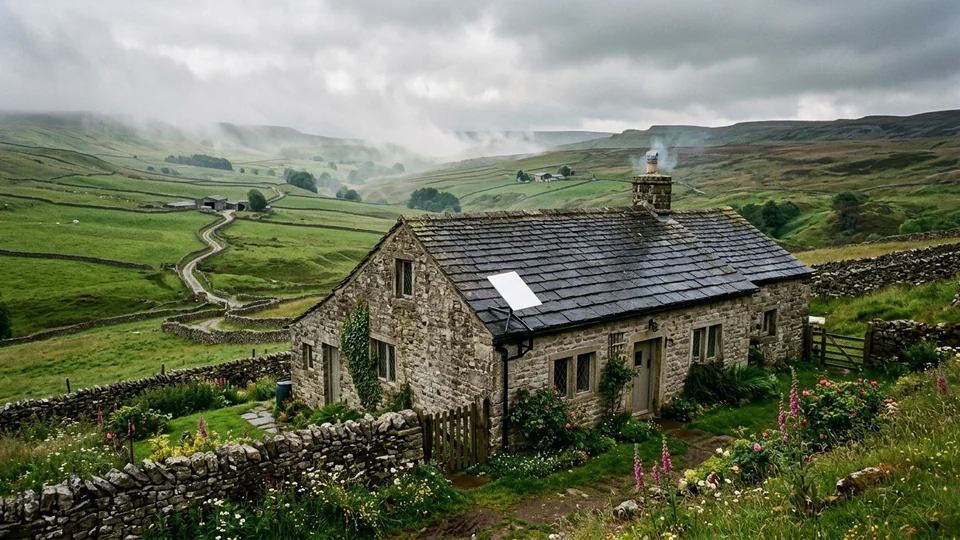
Across thousands of remote farmsteads, coastal Scottish crofts, Welsh mountain villages and Lake District lanes, a single falling ash branch or flooded underground manhole regularly leaves residents cut off from both copper broadband and clear indoor mobile reception for days at a time. Yet rural connectivity across the United Kingdom is shifting quickly. Understanding why legacy rural ADSL and FTTC lines suffer repeated storm damage, tracking full-fibre Project Gigabit rural altnets, building reliable external directional 4G/5G antenna failover, and mounting Starlink low-Earth orbit satellite hubs safely on steep slate roofs ensures isolated rural households stay online year-round.
1. Why Rural Overhead Copper & Distant Cabinets Fail First in Storms
Unlike urban cities buried in reinforced PVC street ducts close to telephone exchanges, rural UK broadband historically depended on kilometres of exposed overhead copper drop wires swinging across country lanes and woodland hedges before reaching green street cabinets fed along rural power poles.
Copper Weather Degradation, Lightning & Cabinet Battery Exhaustion
Years of Atlantic rain corrode outdoor BT gel-crimps inside grey pole distribution boxes, causing crackling impedance faults that slash speeds every time rain settles in. Worse still, when a rural power cut hits a local hillside, the small internal backup batteries inside un-monitored FTTC roadside green cabinets typically keep street VDSL lines powered for barely 1 to 4 hours before silencing entire villages simultaneously—even if your house runs on a whole-home solar battery! Full-fibre FTTP uses passive glass optics right back to larger powered regional exchanges, eliminating vulnerable street cabinet batteries completely.
Checking Project Gigabit Vouchers & Independent UK Altnets
Before spending thousands on private links, enter your rural postcode carefully into our UK Broadband & Full-Fibre Altnet Checker and check official Building Digital UK (BDUK) Project Gigabit contract schedules. Regional fibre builders—including Gigaclear, Fibrus, Wildanet, B4RN (Broadband for the Rural North), Wessex Internet, Openreach rural builds, Airband and County Broadband—are steadily digging buried fibre directly down private farm tracks across previously underserved hard-to-reach postcodes, sometimes supported by government Gigabit Broadband Vouchers reducing upfront rural installation fees.
2. Building Rugged Dual-WAN 4G/5G Cellular Failover Links
Whenever rural full-fibre remains two years away—or as resilient emergency standby for home workers and rural surgeries running full-fibre already—UK mobile 4G LTE and emerging 5G Standalone networks provide remarkably affordable multi-WAN failover once paired with proper outdoor hardware.
Selecting a Rival Host MNO & Aligning Outdoor MIMO Antennas
Never choose a backup cellular SIM sharing the exact same nearby countryside mast pole as your home’s everyday phone if single-mast power cuts occur regularly. Use our UK MVNO Host Network Lookup to identify a second SIM running on a physically distinct regional host (for example pairing an EE SIM with an O2 or Vodafone SIM) whose nearby hill mast carries separate mains power or microwave relay links.
- Avoid Indoor Window SIM Routers: Thick Victorian stone cottage walls, slate roofs and foil-backed PIR loft insulation block weak -110 dBm rural radio signals effortlessly.
- Mount a Roof Directional Cross-Polarised 2×2 or 4×4 MIMO Antenna: High-gain directional Poynting or Iskra outdoor panel antennas mounted neatly onto chimney brackets or gable fascias and wired with short low-loss coaxial cables into an outdoor-capable Teltonika or DrayTek LTE router frequently triple rural 4G download throughput and transform shaky 2 Mbps connections into steady 40–80 Mbps video-calling links.
- Band Locking for Rain-Fade Stability: Locking LTE routers onto 800 MHz (Band 20) or 1800 MHz (Band 3) stops routers hunting erratically between weak 5G cells during heavy moorland mist.
3. Satellite Connectivity Across Highlands, Wales, Pennines & Islands
For isolated Scottish valleys, Dartmoor holdings, Snowdonia cottages and island outposts sitting wholly outside cellular sightlines and planned fibre ducts, low-Earth orbit (LEO) satellite broadband delivers low-latency 35–50 ms performance unmatched by older 600 ms geostationary satellite dishes.
Slate Roof Mounting, Wind Loads & Power-Cut UPS Considerations
Remember three critical practical British weather engineering tips when mounting satellite hardware permanently:
- Clear 100-Degree Northern Sky Horizon: Check tree canopy obstructions beforehand using smartphone augmented-reality sky checkers so tall summer sycamore leaves never drop packets during Zoom calls.
- Heavy-Duty Galvanised Gable Brackets: Standard lightweight balcony stands twist cleanly off exposed UK ridge lines during 70 mph January gusts; specify bolt-anchored wall or heavy slate-cleared pole mounts fitted cleanly with waterproof drip loops entering exterior masonry.
- Keep Satellite Running in Blackouts via UPS: Standard satellite dishes pull roughly 40 to 75 watts continuously (more briefly when winter snow-melt pre-heat activates automatically). Pairing both your primary FTTP ONT and secondary WAN router inside one 1 kWh LiFePO4 power station or pure-sine-wave UPS guarantees uninterrupted Wi-Fi, bank checks and Wi-Fi Calling throughout multi-day rural power cuts.
Automated Dual-WAN Failover Routers for Home Offices
Rather than swapping Wi-Fi passwords manually mid-Teams call, connect both your primary fixed broadband router and your secondary 4G/satellite modem in Bridge Mode into a dual-WAN router (such as UniFi Cloud Gateway, DrayTek Vigor or TP-Link Omada ER605) configured with health-ping failover. Within five seconds of street fibre loss, active packets roll transparently across your backup link. Verify ongoing baseline throughput anytime at UKOutage Broadband Speed Test and check national broadband fault hubs at UK Broadband Outages.
4. Universal Service Obligation (USO) 10 Mbps Statutory Requests
Finally, if your permanent UK residential address remains unable to order at least 10 Mbps download and 1 Mbps upload from any affordable fixed or wireless commercial service (and no Project Gigabit build is scheduled within twelve months), UK law entitles you to invoke the Broadband Universal Service Obligation (USO) administered by BT (and KCOM in Hull). Note that USO engineers run statutory network feasibility studies before quoting connection schemes—where build engineering costs fall below statutory £3,400 per-premises thresholds (or when neighbouring rural cottages pool co-funded community gap costs cleanly), the designated operator must deliver minimum compliant broadband, closing Britain’s stubborn final rural dead zones permanently.
5. Mesh Wi-Fi Through Thick Stone Cottages & Surge Protection
Rural resilience frequently stumbles indoors even after pristine fibre or satellite arrives at an outside gable wall. Sixty-centimetre heritage Cotswold limestone, Welsh slate internal partitions, Cornish cob walls and metal-foil PIR thermal loft insulation attenuate high-speed 5 GHz Wi-Fi signals ruthlessly between cottage rooms.
Hardwired Cat6 Backhaul, Avoiding Double-NAT & Rural Surge Arrestors
Avoid piling slow wireless mesh repeaters upstairs in damp corners where signals bounce weakly off granite; instead, route external-grade weatherproof Cat6 Ethernet cabling neatly beneath eaves or along skirting trims into central ground-floor and landing access points so internal Wi-Fi Calling never stutters mid-conversation. Disable redundant Wi-Fi radios, set strict Quality of Service (QoS) upload queues prioritising Teams/Zoom video calls above cloud backups over constrained 4G uplink paths, and switch consumer ISP hubs into pure Bridge / Modem mode ahead of dual-WAN routers to prevent messy Double-NAT breaks on corporate VPNs, Xbox consoles and VoIP handsets.
Finally, remember overhead rural electricity poles and exposed telephone lines attract fierce induced voltage surges during summer upland thunderstorms—far more frequently than buried London cables. Protect expensive ONT boxes, dual-WAN routers and PoE satellite power bricks by fitting an accredited BS EN 61643 Type 2 / Type 3 surge protection device (SPD) inside your main consumer board alongside a screened UPS unit, guarding vital household connectivity—plus community volunteer fibre cooperatives across isolated parishes—through every season across Britain.