
When the Met Office escalates regional wind, ice or snow forecasts from Yellow to Amber or rare life-threatening Red weather warnings, rural and semi-rural Britain faces real multi-day electricity and telecoms blackout risks. Named winter storms such as Arwen, Babet, Darragh and Éowyn have demonstrated repeatedly how falling trees across isolated 11kV and 33kV overhead wood-pole feeders can sever supply across tens of thousands of homes while blocked lanes delay DNO cherry-picker crews for 48 to 72 hours. Preparing a sensible, affordable British 72-hour blackout kit well before gales arrive turns an emergency into a calm, manageable winter weekend.
1. Interpreting Met Office Warnings & DNO Mobilisation States
Distribution Network Operators begin repositioning engineers, mobile generators and welfare vans days before wind gusts touch British shores. Understanding warning thresholds lets you prepare batteries, water and warmth effortlessly rather than rushing into empty supermarket aisles on the afternoon a storm arrives.
Why Overhead Rural Lines Drop Before Underground Urban Cables
Inner cities such as London, Birmingham, Manchester and Glasgow rely heavily on buried underground 11kV cables insulated from tree strikes unless substation basements flood directly. By contrast, rural valleys across Scotland, Wales, Cumbria, Northumberland, Devon, Cornwall and Northern Ireland depend extensively on suspended overhead poles cutting through forestry corridors and windswept moorland. During Red or Amber wind warnings, follow live regional incidents on UKOutage Power Cuts and verify your local 105 DNO contact card in advance via Who Is My DNO.
Pre-Staging Routine 24 Hours Before Gales Arrive
- Charge every smartphone, tablet and USB-C LiFePO4 power bank up to 100%, and top up laptops needed for remote alerts.
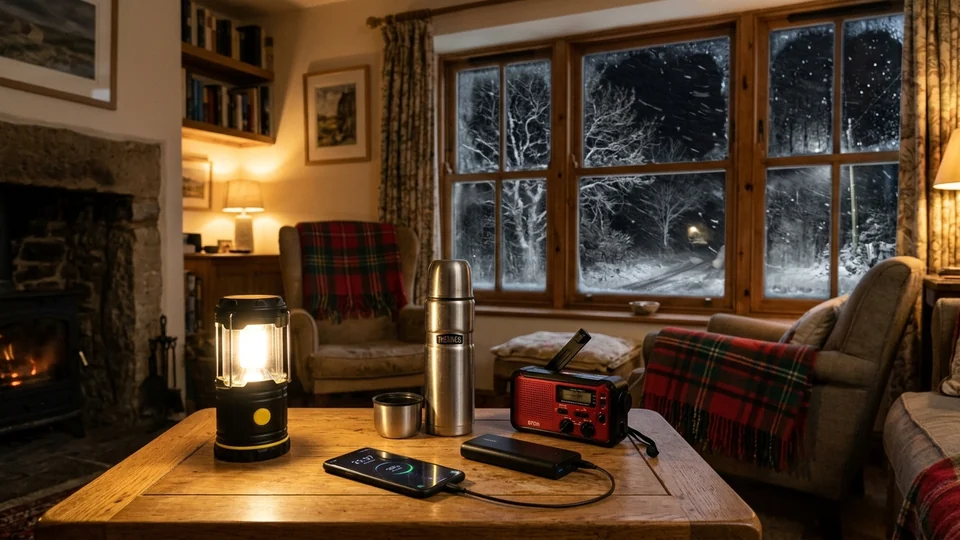
- Fill thermos flasks with boiling water just before bedtime if warnings cover overnight hours, allowing hot tea, soup and infant bottle prep even if electric kettles and induction hobs go dead.
- Verify local street access gates, check Priority Services Register details for elderly relatives living alone in rural postcodes, and confirm they have bright battery torches, warm socks and emergency telephone numbers accessible right beside bedside tables.
- Park vehicles away from mature trees and charge electric cars early to 80–90% ahead of peak gale winds so mobility never relies on dark local street hubs.
2. The Complete British Household 72-Hour Grab-and-Stay Kit
An effective UK household outage kit costs far less than specialist survival gear—most families already own half the essentials scattered across drawers. Consolidate everything inside one clearly labelled grab-bag kept accessible downstairs in a cupboard or hallway:
Lighting, Power Banks, Wind-Up DAB/FM Radios & Cash
- Hands-Free Lighting (Zero Candles): Stock two bright LED camping lanterns plus headtorches for safe stairs and fuse-board checks alongside spare AA/AAA batteries. Never use unattended tea lights or pillar candles during power cuts—UK fire brigades respond to dozens of preventable house fires every winter triggered by candles knocking over onto curtains.
- High-Capacity USB-C Power Banks (20,000 mAh+): Choose reputable Li-ion or safer LiFePO4 battery packs capable of topping up three family smartphones three times each.
- Battery or Wind-Up FM/DAB Radio: When local 4G/5G mast batteries expire around Hour 4 of a rural blackout, BBC Radio 4 (FM 92–95 MHz / 198 LW while operational) and BBC Local Radio FM transmissions continue broadcasting live regional road closures, council warm hubs and storm restoration bulletins straight from high-powered national transmitter sites fitted with multi-day diesel backup sets.
- Physical Banknotes (£40–£60 in small notes): When local broadband and 4G links drop together, village stores often revert briefly to cash-only emergency counters until card terminals reconnect.
Preserving Refrigerated & Frozen Food Safely Under FSA Guidance
Follow clear UK Food Standards Agency (FSA) temperature hygiene during longer blackouts to avoid dangerous food poisoning or wasteful discarding. Keep fridge and freezer doors strictly closed from the first minute power drops—opening doors leaks critical chill air rapidly. A sealed, full domestic freezer safely preserves frozen items for roughly 24 to 48 hours, whereas an average domestic fridge holds safe sub-5°C chill for approximately 4 hours. Throw away chilled meats, dairy, soft cheeses and cooked leftovers once food temperature rises above 8°C for longer than four hours, and never taste suspect chilled meals to test freshness. Carefully refreeze thawed freezer items only if visible ice crystals remain hard inside the packaging.
3. Heating Safety: Gas Boilers, Burst Pipes & Fatal CO Risks
One crucial detail catches millions of British homeowners completely off-guard every winter: even a gas central heating combi boiler shuts off instantly during an electricity cut. Modern condensing gas boilers rely on 230V mains electricity to run circulating pumps, flue extractor fans, ignition spark boards and room thermostats. Keep warm wool layers, thermal socks, blankets and closed curtains locked across south-facing and north-facing rooms to hold residual house warmth inside one main living space.
Preventing Burst Pipework & Avoiding Deadly Indoor Carbon Monoxide
Never—under any circumstances—bring outdoor gas patio heaters, charcoal barbecues, camping gas burners or portable petrol generators indoors, into garages, porches, conservatories or sheds. These devices emit lethal concentrations of invisible carbon monoxide within minutes inside enclosed UK brick and double-glazed spaces. Read full emergency guidelines in our UK Gas Emergency & CO Safety Guide and review generator sizing safely via the UK Backup Generator & Power Station Calculator.
If an extended power cut forces your family to stay elsewhere overnight during hard sub-zero frost, shut off your internal water stopcock and open downstairs and upstairs cold taps briefly to drain standing pressure out of vulnerable loft pipes before leaving.
4. Protecting Landline Telecare During the UK Digital Switchover
Under the national telecoms programme replacing copper telephone exchanges with digital fibre VoIP (often branded Digital Voice), plugged-in corded phones draw power via your home broadband router rather than from exchange batteries as older copper lines once did. If a senior household member relies on a pendant telecare alarm or falls monitor, notify your telecoms provider proactively today so they supply a free compliant router battery backup unit (BBU) capable of maintaining emergency 999 calls across brief power blips—and double-check 999 Emergency SMS registration on family mobile phones as layered redundancy.
Emergency Water Storage, Medical Equipment Alarms & Electric Blankets
High-rise UK flats supplied via electric cold-water booster pumps can lose tap pressure alongside electricity during long blackouts—precisely why storing 12 litres of bottled drinking water per person (roughly four litres daily over 72 hours for hydration and basic food hygiene) inside a cool dark cupboard eliminates stress immediately, alongside simple manual tin openers, baby wipes and pet food tins. Keep critical prescription spares rotated ahead of storms, check sealed internal backup batteries on stairlifts and electric recliner chairs every quarter, and keep spare insulin cooled safely inside insulated travel pouches away from direct ice packs.
Finally, follow strict thermal appliance discipline whenever supply drops during freezing nights: immediately unplug electric under-blankets, fan heaters, hair straighteners, irons and tumble dryers rather than leaving thermostats clicked ON. When street transformers re-energise unexpectedly at 03:00 in the morning, unattended creased electric blankets or clothing tossed beside dormant fan heaters account for avoidable winter post-outage fire call-outs across England, Scotland and Wales. Should sub-zero blackouts drag past 48 hours in rural parishes, check local county council social feeds or BBC Local Radio for heated village hall Local Resilience Rest Centres offering hot drinks, device charging and nurse check-ins, and check elderly neighbours early whenever safe.