
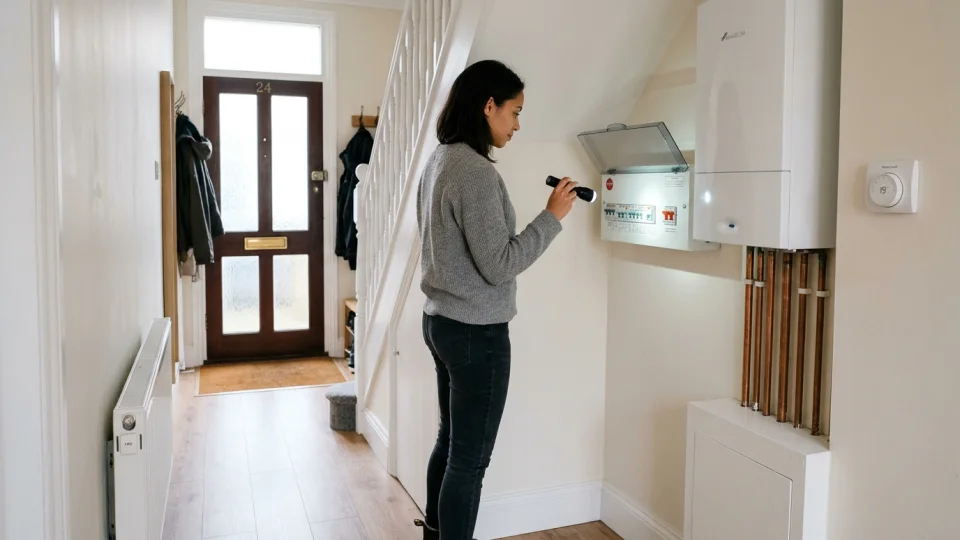
When lights go out, radiators turn ice-cold, or taps dry up inside a privately rented flat, shared House in Multiple Occupation (HMO) or leasehold tower block, British tenants immediately face a confusing responsibility split. Does the emergency sit outside in the street under your Distribution Network Operator (DNO) or water company—or inside a failed communal booster pump, perished flat consumer unit or locked combi boiler that your landlord or managing agent is legally compelled to fix urgently?
1. Street Utility Fault vs Landlord-Owned Internal Equipment
Calling 105 or waiting passively for utility vans wastes vital hours if the root fault sits behind your landlord’s communal plant room door. Use this four-point separation check before chasing either emergency lines or letting agents:
| Clue Inside Building | Likely Fault Owner | Immediate Responsible Contact |
|---|---|---|
| Streetlights & Neighbouring Buildings Also Dark | Regional Electricity DNO (street cable or substation failure) | Dial 105 free (03457 643 643 in NI) and check live UK grid telemetry. |
| Only Your Flat Dead, Hallway Lights Still Working | Flat RCD/MCB trip, faulty landlord immersion/appliance, or meter credit cutoff | Inspect flat fuse box switches once safely; if breaker refuses to reset, notify landlord/agent immediately as an urgent electrical hazard. |
| Cold Water Works on Ground Floor, Dry on Upper Storeys Only | Private landlord/managing agent communal hydro-pneumatic booster pump failure | Block managing agent / freeholder emergency maintenance line (public water mains outside are usually pressurised). |
| Gas Hob Works Normally, Radiators & Hot Water Dead | Internal landlord combi boiler pressure drop, frozen condensate pipe or faulty diverter valve | Landlord / letting agent Gas Safe repair team under Section 11 urgent heating duties. |
2. Statutory UK Landlord Legal Obligations (England, Wales, Scotland & NI)
Across the UK housing nations, landlords cannot escape urgent infrastructure repairs by pointing toward contract small print or delayed contractor quotes. Key statutory protections back up tenants when power, clean water or winter heating fails:
- England — Section 11 Landlord and Tenant Act 1985 & Homes (Fitness for Human Habitation) Act 2018: Section 11 strictly obliges landlords to keep installations for the supply of water, gas, electricity, sanitation, space heating and hot water in continuous working repair. Total loss of heating or hot water during cold autumn/winter weather, or total loss of internal electricity/water rendering a home unsafe, is classified by Shelter England and local councils as an urgent priority repair requiring immediate same-day or 24-hour action (and reasonable temporary fan heaters where spare boiler parts take longer).
- Wales — Renting Homes (Wales) Act 2016: Contract-holders are protected by strict Fitness for Human Habitation (FFHH) standards plus mandatory working smoke/CO alarms and five-year Electrical Installation Condition Reports (EICRs); landlords face strict non-recovery of rent if premises become genuinely uninhabitable due to unresolved essential service failure.
- Scotland — Repairing Standard (Housing (Scotland) Act 2006): Landlords must keep electrical, gas and water installations safely operational at all times, backed by rapid binding tribunal enforcement through the First-tier Tribunal for Scotland (Housing and Property Chamber) if landlords drag feet.
- Northern Ireland — Private Tenancies Act & Environmental Health: Tenants can escalate unaddressed loss of essential heating, electricity or water directly to local council Environmental Health officers, who hold statutory powers to serve formal Repair Notices.
3. Shared HMOs, Meter Cupboard Access & Five-Year EICR Laws
In converted Victorian houses and licensed HMOs, one critical life-safety snag emerges during outages: individual bedsit tenants sometimes find the main electricity intake cupboard, communal RCD board or gas Emergency Control Valve (ECV) locked inside a ground-floor hallway cupboard or basement utility room that only the landlord can open. Under UK Electrical Safety Standards Regulations and HMO licensing rules, tenants must have safe access to isolate their own circuits in emergencies, and landlords must hold a valid, passed 5-year EICR certificate plus an annual CP12 Gas Safety Record covering every gas boiler and hob.
Never allow an uncertified handyman to reset tripped high-voltage intake gear, wire bypass jumpers across fuses, or meddle with gas boiler covers—under UK law, only a Part P registered electrician or Gas Safe registered engineer may repair landlord utility installations.
4. Who Receives £95 Ofgem Power Cut or Ofwat Water Compensation When Bills Are Included?
Confusion flares frequently around statutory utility compensation when a neighbourhood street outage qualifies for Ofgem £95+ power cut payouts (12h+ failure) or Ofwat GSS water outage credits:
- Bills Registered in Tenant’s Own Name: The tenant is the named customer on the energy/water account. Call 105 or register your Ofgem £95 claim directly with your regional DNO (or water company) citing your MPAN/bill reference—credits belong 100% to you, not your landlord.
- All-Bills-Included Tenancy or HMO Licence: Statutory payouts from energy suppliers or water wholesalers legally route to the named account holder (your landlord or student accommodation operator). Ask transparently whether the landlord received a statutory outage rebate, and verify whether your tenancy contract includes pro-rata interruption abatement if unaddressed landlord plant failures (rather than external DNO cuts) left the property without heating or power for extended days.
- Tenant Priority Services Registration Still Applies: Even where bills are included in rent, elderly tenants, pregnant residents, parents of under-5s or tenants with medical hardware should register their own mobile phone and flat number on the Priority Services Register (PSR) directly via 105 and the local water company so welfare teams alert you firsthand rather than only messaging an absentee managing agent.
5. Leasehold Blocks, Communal Heat Networks & Prepayment Meter Debt Left by Former Tenants
Leasehold apartment blocks and modern city developments introduce a further layer of shared responsibility between individual landlords, Resident Management Companies (RMCs) and District Heat Network operators. Where heating and domestic hot water flow from a central communal plant-room CHP boiler or Heat Interface Unit (HIU) inside your airing cupboard, your individual flat landlord rarely controls the basement plant—yet still owes immediate liaison with the managing agent to restore heat and supply temporary fan heaters under Section 11 obligations. Furthermore, under current Ofgem Heat Network consumer protection reforms, heat network residents are gaining formal statutory dispute escalation routes alongside traditional gas and electricity users.
Meanwhile, incoming renters moving into a property sometimes discover on day one that a smart prepayment meter is locked off due to arrears built up by the previous tenant. You are never legally liable for a previous occupier’s energy debt: photograph the opening meter serial number and balance reading immediately on move-in day, keep a copy of your signed tenancy agreement ready, and contact the energy supplier’s home-move team straight away to issue a clean reset or 20-digit UTRN clearance code so you can run heating smoothly (see also our Smart Meter Prepayment & UTRN guide).
6. Escalating Ignored Utility Repairs Safely Without Self-Help Risks
If your landlord or letting agent ignores an emergency winter loss of electricity, water or heating past 24 hours despite written SMS and email notice:
- Document Everything Timestamped: Photograph blank boiler error codes, dead fuse switches, thermometer readings indoors and every call/message log—plus verify external neighbourhood grid state on UKOutage’s postcode & DNO directory to prove the fault sits inside building installations rather than street cables.
- Contact Your Local Council Private Sector Housing / Environmental Health Team: Councils inspect Category 1 excess-cold and electrical hazards under the Housing Health and Safety Rating System (HHSRS) and hold statutory powers to serve emergency Improvement or Prohibition Notices compelling rapid landlord repair—or carry out works in default and recover costs from the owner.
- Use Statutory Pre-Action Protocols Before Direct Offset: Never simply cancel standing-order rent payments without formal housing adviser guidance—withholding rent carelessly can expose tenants to possession arrears notices under Section 8 even when repair grievances are genuine. Seek immediate written advice from Citizens Advice or Shelter before using the strict common-law notice-and-offset procedure on emergency repairs.